By Yaldaz Sadakova
Packing up my life and leaving a place is a skill I’ve perfected.
The secret lies not so much in how you pack, but in what you do during the months or years before the departure. You must be careful not to accumulate much.
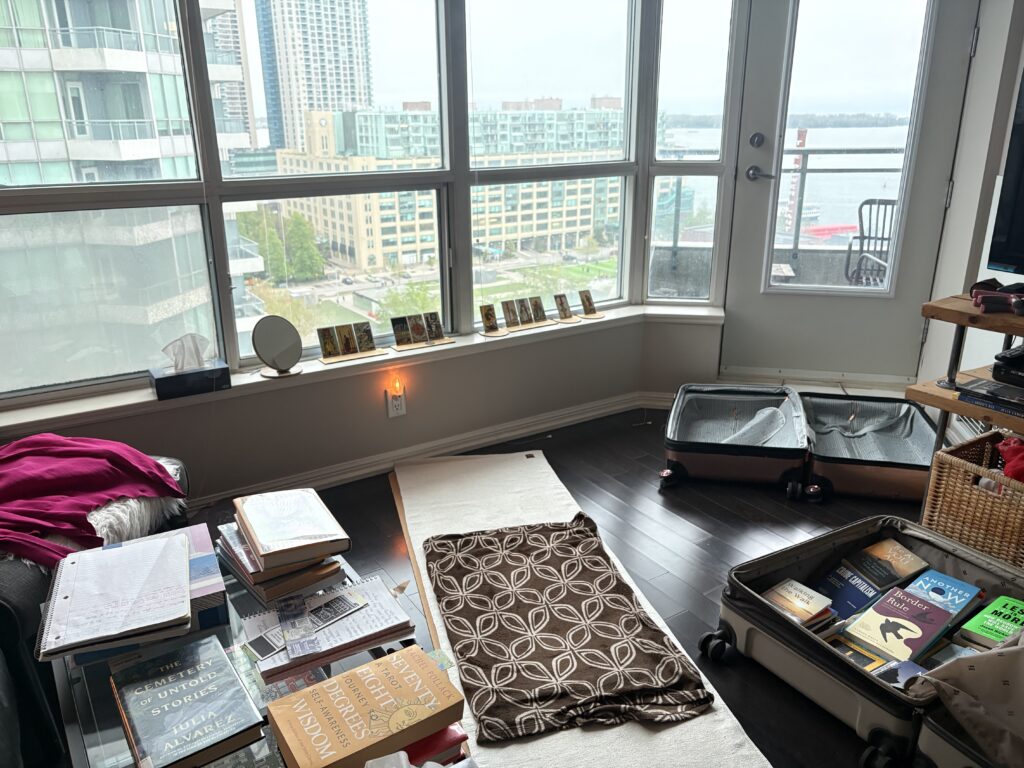
As I prepare to leave now, with three suitcases splayed out on my living room floor, I have the dreadful realization that I’ve broken my rule. I have more stuff than there’s room for. More stuff than a nomad ever should.
It’s not the clothes. I’ve managed to cram those in one suitcase. Plus, I already donated many of my sweaters, all my jeans, most of my shoes. And yesterday I threw away my old winter jacket. My famous brown parka was torn at the shoulder, literally. I bought it in 2014, during my first year here in Canada, when I finally figured out that you cannot survive the nine-month-long winters in this country without a proper jacket.
What’s weighing me down this time are books and journals. I didn’t use to keep a diary before Canada, so this is a new problem. I still can’t decide whether it’s worth transporting across the ocean all 25 of my journals, whether it’s worth keeping this unvarnished physical record of my interiority.
While I try to zip up the biggest suitcase, a ship foghorn sounds outside. I look through the window. The lake is turbulent. The rain has picked up. Toronto is crying for me. It’s okay to cry. I’ve been crying too. We will miss each other.
At least Toronto will have spring to console it: the trees are finally blooming. It was about time. It’s the end of May.
The Revelation
Going for walks along the lakefront has been one of my big pleasures while living in this apartment. Especially at night, when the waves are black and shimmering with moonlight, the expanse of water feels liberating. Anything is possible.
This apartment has served me well. I came here five years ago, after ending a relationship with the person who I thought would be my lifelong partner. The person who made Canada home for me, who clapped proudly in the audience during my Canadian citizenship ceremony. The person who brought the ancient philosophies of the Indian subcontinent to me. Here you go, along with my heart, you can have the wisdom of where I come from.
Although we both embraced that wisdom, over the years it became apparent that we couldn’t continue in the same direction. He wanted kids. I didn’t. He wanted to spend the rest of his life in Canada. I didn’t. Our paths had to diverge.
This apartment has absorbed my grief about letting him go. And my guilt about breaking up with him when he wasn’t expecting it.
It’s also where a spiritual process came to an end for me.
For the longest time ever, I’d sought something I couldn’t name. I went from place to place, looking for that thing.
That thing, it turns out, was meaning, a philosophy to guide me. The one I grew up with in Bulgaria always felt foreign and irrelevant to me. It had nothing to say about a misfit like me. It was also too bleak, too “every man for himself.” Then again, Bulgaria in the 1980s and 1990s, and even in the 2000s, was a bleak place. In many ways, it still is.
So I rejected what I’d been taught. That left me with nothing, though. It turned me into a hollow shell.
Here in this apartment, I completed the process of finding a guiding philosophy. Or rather, the process of crafting one for myself. It’s my own eclectic mix. Veganism, environmental socialism, science, Enlightenment, Vedanta, Vipassana meditation, Buddhism, astrology, tarot. All in different amounts, depending on the situation.
The guiding philosophy I found, the big revelation, is this: the present is all we have. Every single moment is an opportunity to practice self-awareness and compassion for ourselves and all living beings. The root cause of all suffering is attachment—to the past and its sunk costs; to possessions, people and places; to expectations, ambitions and ideologies.
So it turns out that the secret I was looking for is simple. It can be expressed in just a few words: be present and compassionate, release attachment. The hard part is practicing it. That’s a lifelong task.
Oh, there’s another ancient secret I discovered. It comes from Advaita Vedanta and it blows my mind. It says that separation is an illusion. We’re all one. This real life that we think is real isn’t real. It’s a dream state, just like the state we enter when we fall asleep. Permanence and safety are an illusion. Death is an illusion. The only real and eternal thing is universal consciousness. You are that universal consciousness, rather than a separate human.
The late Advaita Vedanta teacher Nisargadatta Maharaj sums it up well: “The real does not die, the unreal never lived. Once you know that death happens to the body and not to you, you just watch your body falling off like a discarded garment. The real you is timeless and beyond birth and death. The body will survive as long as it is needed. It is not important that it should live long.”
Reading these words always feels like a psychedelic trip for me.
These concepts can indeed sound like the outcome of smoking some potent stuff—especially to those of us steeped in a materialistic, rational, dualistic, “mind and body are separate” worldview which is informed by monotheistic religions, a linear understanding of time and capitalist dogma.
But if you grew up immersed in Indian cosmologies, the concepts of non-separation and circularity are not unfamiliar. They’re not a mind-altering substance.
Also in this apartment overlooking Lake Ontario, I learned that the home I had been looking for…well, I had searched for it in the wrong place. I expected it to be in plain sight. It was actually hidden from my view.
What I had to do was turn around, head in the opposite direction, embark on a long journey halfway across the earth, and upon reaching my faraway destination, go to a secluded spot on a remote beach. The home I found was a magnificent cottage floating on the water. A peaceful place with the tide as its fluid foundation, a refuge where my mind-body can heal and rest.
This floating house is inside of me, but it’s also everywhere. However, at the end of the day, it’s a figment of my imagination, an intellectual construct. Just like all the comforts and assurances I seek when navigating the practical plane of my existence.
Falling Out of Love
Why am I leaving the place where I found my home?
It’s a long story. The short partial version is that Toronto is no longer the city I fell in love with. In the 13 years I’ve lived here, it has deteriorated a lot.
Housing has become ever more unaffordable, life ever more precarious, with minimum wages that can’t cover the bare minimum. The number of homeless people has skyrocketed. There are no meaningful social safety nets—a chilling reminder even to those of us who don’t need the government’s help that we’re only one lay-off or one health crisis away from ruin.
What about the famous free healthcare? It’s still free, when you can get it. There’s a shortage of doctors and medical staff. It can take months to see a specialist or get surgery.
Public transit is falling apart, too. Riding the subway is nothing short of a gamble these days. You may or may not reach your destination (on time). More likely than not, your subway line will be down.
We’re paying some of the highest taxes in the world – which I’m happy to do! – but our public services are abysmal. It doesn’t have to be like this.
Not to mention that Toronto is so far from Bulgaria, which makes it hard to visit my mom. Those tearful annual goodbyes at Sofia Airport have become more unbearable with each passing year. They’re not worth it anymore.
I also feel an overwhelming sense of closure, of a chapter coming to an end. I prefer to initiate the next chapter, because I fear that if I don’t, the new beginning that is needed will be forced on me through some kind of external crisis.
So I gave up this beautiful but overpriced apartment overlooking the water. I resigned from my nice safe job. I canceled my home insurance, my home internet, my phone plan, my weekly deliveries of local organic produce. One by one, I dismantled the structures of my Canadian life. Then I said goodbye to my friends and coworkers.
The thing I will miss the most about Toronto is the diversity. It’s one of the most multicultural spots on the planet. It’s the kind of place where the troubled relationship I have with my Turkish and Bulgarian heritage doesn’t hinder me. Nobody in this city cares about my background and I love that. Being a minority is the norm here, so I fit right in.
However, that’s not enough to keep me in Toronto, even though I might return because this city will always be a home to me.
There is also diversity in the country I’m heading to, but of a different type.
New Beginning
A few weeks before the mess of suitcases in my living room, I pulled a tarot card for my birthday.
Ace of Wands.
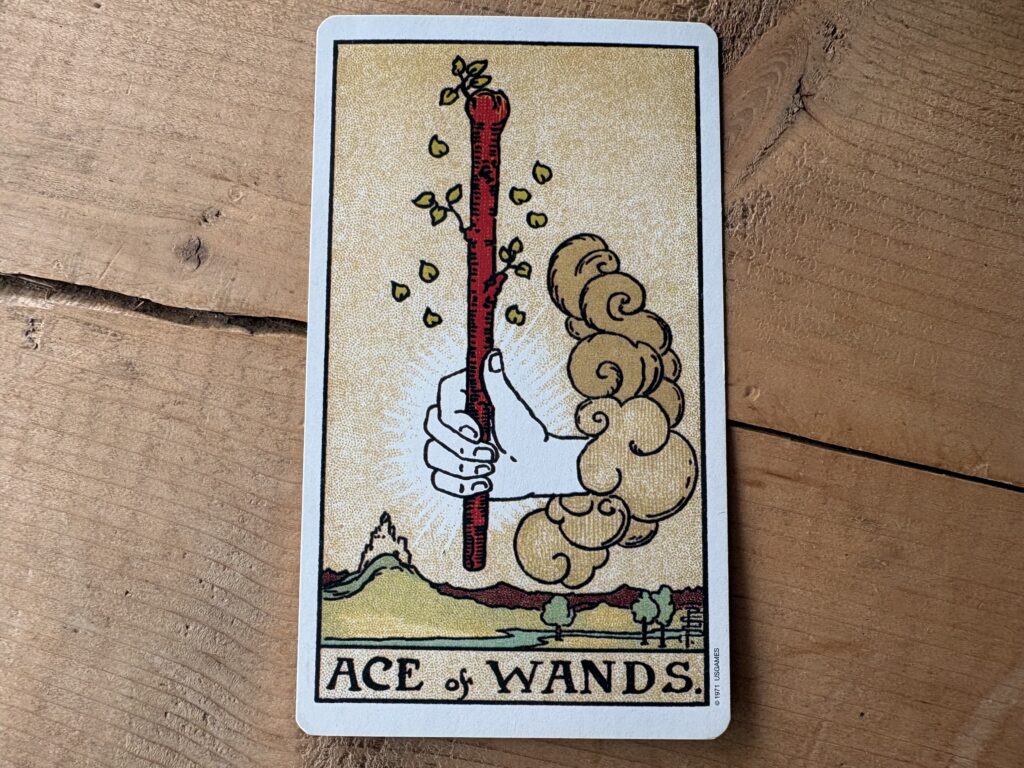
In the foreground of the card, a hand emerges from a cloud. It’s holding a single wand with budding leaves. The background shows a winding stream, green trees and a castle. I can almost hear the birds chirping in this landscape. I can smell the fresh grass.
The Ace of Wands is all about new growth, spring, a powerful beginning. A beginning with a fiery flavor, because the wands suit in tarot represents the element of fire.
This means a beginning that you may not be ready for. But because you feel the urge, you must act on it and do so with courage. Even if you don’t know all the steps. Which of course you won’t.
I’ve noticed that when I start something big, I don’t know what I don’t know. But clarity comes to me from action, not from contemplating, researching endlessly, listing pros and cons. Act first, adjust later, the card counsels. Do not succumb to analysis paralysis. Follow your enthusiasm.
I like the card. It feels like a nod from the universe, a good luck wish, a reassurance that things will work out.
I will certainly need this for my new chapter in Brussels.
Nothing awaits me there yet. No job, no apartment. What I have are my creative writing projects, which are not something I can support myself from. (Yet.)
The uncertainty is nerve-wracking, but also exhilarating. When nothing is predetermined, anything is possible. In fact, I’m mostly stoked and optimistic. It’s irrational how enthusiastic I feel about this move.
I’ve learned that when I follow my excitement and instinct, even if they make no sense, things turn out well for me. By that I mean: I end up having profound experiences which change the course of my life for the better. Big risks have always paid off for me, but never in the ways I imagined. I’m counting on my luck again.
The Stepchildren of Europe
Back in 2010, I moved to Brussels at the height of the euro crisis. I was miserable every single day during the two years I spent there.
I was depressed and angry because I had been forced to leave New York a year earlier, after failing to get an H1B work visa. I spent the entire two years in Brussels grieving the loss of New York. My body was in Brussels, but my heart was in New York.
What made things worse was my work situation in Brussels. In fact, that was the main reason for my misery. I couldn’t get work in the city not only due to the financial crisis, but also due to my Bulgarian nationality. Back then, Bulgarians and Romanians needed a work permit to access the Belgian labor market despite being EU citizens. We were the stepchildren of Europe. This forced me to work for myself, doing something that made me deeply conflicted.
Every day brought reminders of what I couldn’t have. I was in the candy shop, but I couldn’t eat any of the candy.
Meanwhile, many European expats around me seemed to be living their best lives. They bragged about how much they enjoyed Brussels. How they loved their internships and jobs in the EU bubble, the expat networks they belonged to, Thursday nights at Place Lux, the parties, the waffles, the beer, the cheap wine. And I was like, are we even living in the same city?
I did get to enjoy the cheap wine, way too much of it, precisely because it was cheap. I enjoyed the waffles too, but not the freshly made ones sold in the touristy spots—the ones topped with whipped cream, strawberries and fudge. Those were out of my budget. I bought my waffles from Delhaize: 10 store-brand waffles in a sleeve for a euro.
I don’t regret that Brussels chapter. Without it, I would have never been able to understand certain things about Europe, immigration and myself. I would have never been able to write about them later.
As I prepare to return, a part of me wants a European do-over. Now that Bulgarians have the right to work in Belgium and the rest of the EU without a permit, I want to see what it’s like to partake in the quintessential European experience.
The part of the European experience I am particularly excited about is traveling easily across the continent via train. A quick getaway to Berlin, a last-minute trip to Amsterdam, a long weekend in Paris. The things people take for granted when they live the European dream. It’s something I never had the money to do the first time I was there.
Maybe I can finally taste some of that EU candy.
Even if it’s stale, even if it’s the last remaining chocolate truffle in the box.
The Party Is Over
Despite my excitement, I can’t shake the feeling that by moving to Brussels now—or anywhere in Western Europe, for that matter—I’m joining the party at its tail end. I received the invite to attend, but I’ve showed up too late.
The music has stopped. The blue and yellow balloons hanging from the ceiling have deflated.
The guests have left, except for three young drunk men standing in a corner. They’re lamenting the decline of the West, how the reason for that decline are migrants and Muslims.
Ahhh! Europe’s two most convenient scapegoats.
A previous version of me would have tried to convince these men with facts and statistics.
But I’ve had to accept that people generally don’t respond to facts. They will believe what they want to believe. Plus, why should we have to justify the existence of migrants and Muslims? How dehumanizing.
I shift my gaze from the drunk men to the empty wine and beer bottles littering the table and the floor. All the booze at the European party is gone.
So is the food, unless you count the scraps of pizza left over in several boxes, the few crackers and chips sitting at the bottom of a serving bowl. And yes, that last cocoa-dusted chocolate truffle which I’m eyeing.
Europe’s era of abundance, the comfortable life that came at a cheap price—which is the promise that was sold to us in Eastern Europe when we emerged from communist rule and later when we joined this club of the rich—all of that is pretty much over.
Although our Eastern European passports have the EU stamp of belonging, it’s too late. Western Europeans got to enjoy the good life for decades on end, but for us in the East, the stepchildren of Europe, things are ending when they have just begun.
And bit by bit, our EU rights are being eroded.
In preparation for my move, I learned that Belgium has made it harder for EU citizens to register their presence in the country and apply for residence. I felt robbed.
It looks like other member states have also made it harder for EU citizens to settle there and access social safety benefits. EU citizens still have the legal right to move and settle within the bloc, but in practice, it has apparently become more difficult to take advantage of this right. Also, certain countries have reintroduced border checks within the EU. This is supposed to be a temporary measure, but let’s see how temporary it will be.
On my pessimistic days, I fear that if the EU was to disintegrate, that’s exactly how it would happen: not with a dramatic collapse that makes the front-page news, but incrementally, bit by bit, just like in the boiling frog fable. Over time, various EU rights and privileges will disappear, but nobody will protest. Because the change will be so gradual, we will adjust to it, like the frog being slowly cooked to death in a pot of boiling water.
Until one day we wake up to a union that exists only on paper. Sure, we’ll still be EU citizens, we’ll still have EU rights on paper, but we’ll no longer be able to exercise them, to travel or settle freely in the rest of the bloc. The European Single Market will be single in name only.
Ервопейци, но само на хартия.
No Escape
Someone recently posted on a Facebook forum that they’re moving to Brussels and looking for tips about settling in the city. One person responded, “Belgium is a mess right now, go somewhere else.”
I laughed at this advice. The things that are messing up Belgium—far-right politics, racism, inflation, unemployment, public service cuts, dwindling energy resources, extreme weather due to climate change, contamination of water and soil with forever chemicals, and so on—well, they are everywhere. These issues are prevalent worldwide now.
Целият свят се обърка вече, as my mom reminds me during our weekly calls.
There’s no escaping these systemic ills, all of which are interconnected. The only way forward is to fight them.
We need to do that in a way which is intersectional, but also collective, organized and global. We need to create a new international Left.
There are already great progressive ideas out there, but they haven’t permeated mainstream media and culture the way far-right ideas have.
We need to put a bold manifesto in the mainstream, not just in Leftist spaces. A vision that can offer hope to the international public in these times of crisis, when everybody feels that the ground is shifting beneath them, but they have no power as individuals to change anything.
We need practical proposals about how to avert planetary destruction and redistribute wealth on a global scale.
The economic anthropologist Jason Hickel lays out a sensible inspiring framework in his book Less Is More: How Degrowth Will Save the World.
He advocates for eliminating the economic activities that harm the environment, such as fossil fuel extraction, weapons manufacturing and beef farming.
At the same time, he calls for ramping up the production of socially useful things, like healthcare, mass transit, housing, education, childcare and eldercare. And, just as importantly, he calls for de-financializing those things, so that profit is not the defining motive behind them and we can all access them at no cost or low cost.
This ecosocialist vision also entails raising wages and reducing the work week.
While our Leftist blueprint should be international to reflect the global nature of the problems we face, the policy solutions need to be diverse and flexible enough so they can be adapted to local circumstances.
But isn’t this kind of overhaul too complicated, too idealistic? I can hear skeptics ask. You can’t just do that overnight.
Yes and no. If there’s one useful thing the reign of a certain president has demonstrated to the entire world, it is that policy can in fact change overnight. Just with the stroke of a pen. It can change for the worse.
Or for the better.
I’ve heard Hickel say many times that we live in a shadow of the world we can have. It always gives me goose bumps.
Daring to Be a Fool
The suitcases aren’t fully packed yet, but I’m getting there. I will have to decide soon whether to take my journals. I look at the Ace of Wands, which I have propped up on the window sill of my living room, for reassurance. Yes, I still feel stoked about what’s ahead.
Am I a fool to uproot myself in a time of global chaos, with my head full of fantasies, instead of staying put? I sure hope so.
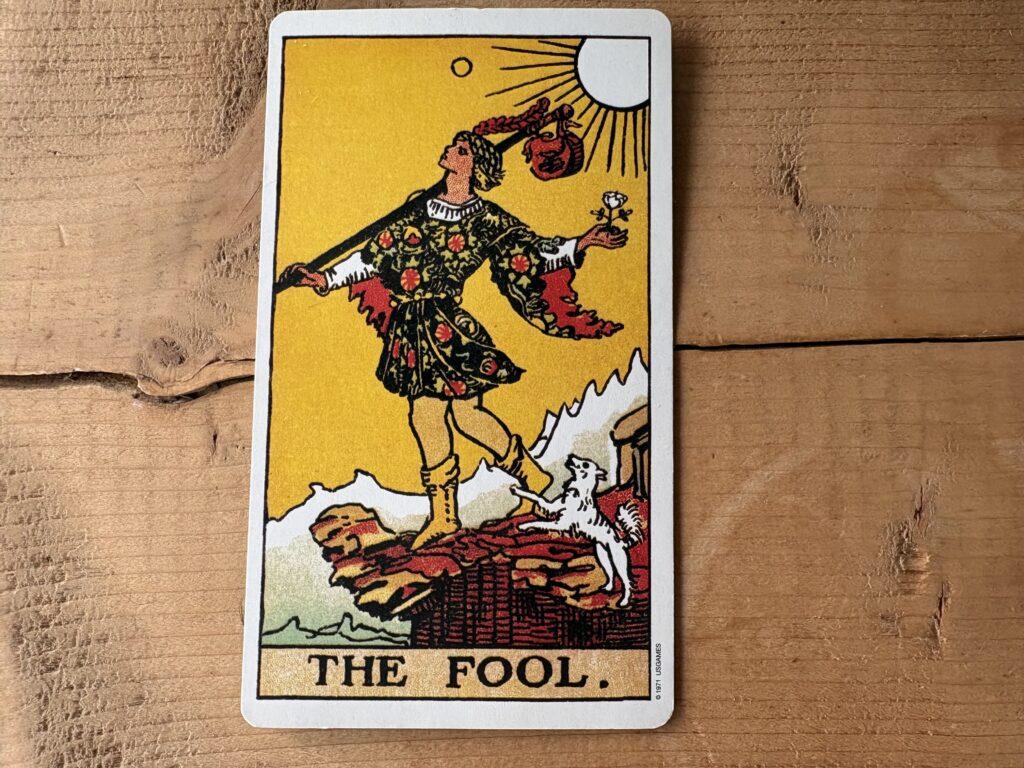
I also happen to have The Fool card displayed on my window sill for inspiration. It’s the first card in the Rider-Waite tarot deck, marking the start of the hero’s journey through the 22 stages (cards) of the major arcana. Like the Ace of Wands, it represents a beginning.
But this is an even more electrifying beginning. It’s about embarking on a life-changing, unorthodox, “hold onto your yoga pants” journey. It’s about irreversible change, both personal and social, that strikes like a bolt of lightning and comes seemingly out of nowhere.
The card shows The Fool mid-stride, about to jump from the edge of a cliff, looking inexplicably calm and poised. In the Marselle tarot, The Fool’s pants are torn at the back, revealing his naked butt. This card is all about taking the kind of leap that puts your vulnerability on public display and invites ridicule.
The Fool is escaping what is by all appearances a good safe life. He knows that safety is an illusion. He doesn’t get too comfortable with it. He follows his urge to walk away from what he has outgrown. This isn’t juvenile rebellion, fleeing just as a fuck-you because you didn’t get your way. It’s a conscious decision to leave what no longer works despite your best efforts, while honoring the gifts it gave you.
Full of gratitude, The Fool initiates the disruption, instead of being blindsided by it. He’s the architect of shocking change, rather than the object of it.
He knows, however, that even as an initiator, he has serious limitations, because a lot will be beyond his control, beyond his realm of knowledge. But at least he’ll never have to regret living small and missing out on self-actualization opportunities.
Hence the look of serenity on his face.
For the life-changing journey The Fool is about to begin, he’s carrying just a small bag. (Unlike me.)
What’s in it? Material possessions, according to many tarot practitioners.
But the late tarot writer Rachel Pollack interprets it as a bag full of life experiences. “He does not abandon them, […] they simply do not control him in the way that our memories and traumas so often control our lives,” Pollack writes in her classic Seventy-Eight Degrees of Wisdom.
Behind the Fool, the sun shines bright, unobscured by clouds. I was going to say that it illuminates his path ahead, but there’s no path. Just an abyss. Le Fou will have to forge his own path after he falls in the abyss.
I hope the sun fills him with confidence for daring to be a fool. ♦
NOW READ: